
 Ask an Engineer
Digital Integration in Motion Systems Starts With Collaboration
By John Fenske on July 8, 2026
The best motion systems share a common trait: mechanical, electrical and controls teams are aligned on the architecture before major decisions are locked in. When that collaboration happens early, constraints like feedback protocol compatibility, load cell placement and cable routing get resolved in design — where they’re far easier to address. Modern actuator design is moving in this direction and the results speak for themselves.
This approach reshapes the first question on a motion project. Rather than narrowing in immediately on force and speed, the team can start by asking: What does the machine need to accomplish? That broader objective lets the entire engineering team address bandwidth, feedback, cable routing, compliance and environmental constraints before major decisions are locked in.
Digital Integration Is a System Decision
Servo-system performance depends on the complete electromechanical system, not on a single mechanical component or a control algorithm alone. Getting the controls team involved early — before the design is finalized — ensures that a mechanically sound actuator is also a controls-ready one. The same is true for electrical decisions: feedback, wiring, power cabling and environmental protection work best when they’re part of the original design conversation, not implemented around decisions that were already made.
Early collaboration is especially important in hydraulic or pneumatic conversions. Replacing a cylinder with an electric actuator is not usually a one-for-one swap. Electric systems introduce different size, cost, power and control considerations. That makes conversion an opportunity to redesign the motion system around the process, rather than simply replicating the old architecture with new components.
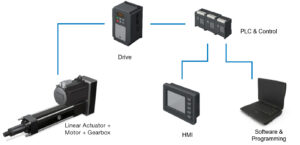
Integrating mechanical, controls and power for a systems approach to linear motion.
Integrated Motion Data
Digital integration is also changing what actuator data can do. Force sensing and position sensing are already part of many actuator designs. Temperature, vibration and diagnostic data are becoming more important because they can help teams understand actuator life and performance. In some applications, the same force data may be used after the fact to review a process. In others, it becomes part of real closed-loop control.
Post-process data collection and closed-loop control place different requirements on the actuator, feedback path and controller. In force-critical tasks such as pressing, clamping or welding, the design team must define force requirements early in the process. It also must determine where the load cell is placed, whether the environment will affect it, how the signal will be conditioned and amplified, and whether the programmable logic controller (PLC) and drive can read and respond to the signal fast enough.
Mechanical stiffness is part of the same discussion. Compliance in the actuator, tooling or surrounding structure can become an error source during force control. Actuators designed around integrated load cells and stiff mechanical structures reduce some of that stack-up, but only if the actuator, tooling and controls are selected together.
Feedback and Drive Fit
The practical side of digital integration shows up when an integrated actuator has to work with a third-party servo drive. Feedback selection depends on resolution, accuracy, temperature, shock and vibration. If the application must retain position after power loss, a multi-turn absolute encoder can preserve position information and eliminate the need to rehome the actuator on restart, even if the device was moved while unpowered.
Smart feedback adds another layer. Some feedback devices can store actuator or motor file information, fault history, live temperature data, diagnostic information and machine-safety data. Absolute encoder protocols can also be a major integration constraint because some servo-drive manufacturers accept only certain protocol types or use proprietary feedback devices and communication protocols.
Drive matching is just as important. The actuator and drive must be checked for encoder compatibility, peak and continuous speed and force, peak and continuous current, voltage requirements and operating mode. Cable type and length also affect the system. Long power cable runs can reduce motor insulation life, while long feedback cables can introduce intermittent faults due to signal degradation.
Plan the Data Path
Digital integration works best when the data path is designed with the motion path. Define the motion and load requirements, validate best- and worst-case scenarios, check the sizing calculations and review the selected actuator, feedback, drive, cables and environmental protection as one system.
This approach keeps the system on track from day one. Treating digital data as a first-class design input means fewer late-stage surprises — especially when force, position, temperature or diagnostic data need to be part of the control architecture. Read our integration guide to learn more.